
Anyone interested in a digital marketing career wants to know a digital marketer’s exact career path. They want to understand the skills that will get them into this dynamic field, the different roles digital marketers play, and how their career progresses. When they can’t find answers to these questions, they are left confused and doubtful about their decision.
In short, a digital marketing professional is someone who uses online and other digital channels to promote brands, products, services, or organizations. Often, this is done with the goal of increasing sales and revenue, though that isn’t always the case. Some companies may hire a digital marketer to grow or improve their brand image, either with potential customers or potential candidates.
Nonprofits and community organizations also hire digital marketers to build their audience or draw attention to an important cause. Because the field is so broad, having a clear “Best Digital Marketing Roadmap” is essential to avoid burnout and focus on the skills that actually lead to employment.
In this guide, we will break down the exact journey from a complete novice to a high-earning professional, covering AI integration, B2B strategies, and a dedicated 6-month learning plan.
Digital Marketing Roadmap for Beginners
The journey into digital marketing often feels like staring at an overstuffed menu. There are too many options, and everything looks important. However, the best digital marketing roadmap for students with no experience starts with the fundamentals. You cannot build a house without a foundation, and you cannot run a million-dollar ad campaign without understanding why people click on links.
Phase 1: Understanding the Core Pillars
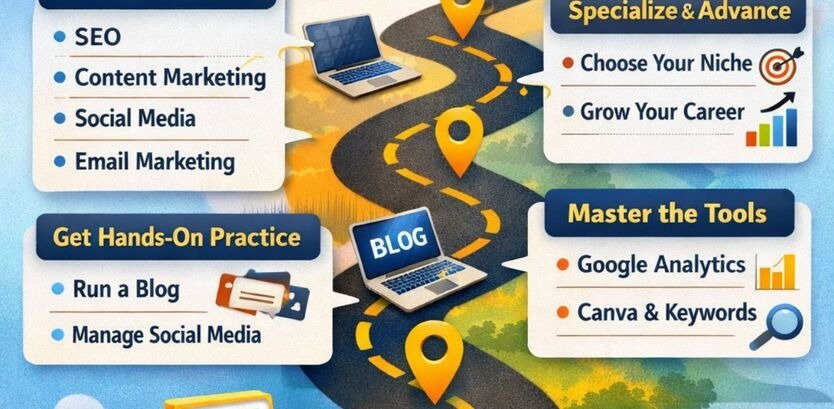
Before touching any software, you must understand the four pillars: Search Engine Optimization (SEO), Content Marketing, Social Media Marketing, and Email Marketing. SEO is the art of making websites visible on Google. Content Marketing is the fuel the blogs, videos, and infographics that provide value.
Social Media Marketing is about community and engagement, while Email Marketing remains the most effective way to convert leads into customers. At this stage, your goal isn’t to be an expert; it’s to understand how these pieces fit together to create a “marketing funnel.”
Phase 2: Connecting Skills to Remote Roles
The beauty of digital marketing is that you can earn while you learn. Once you understand the basics, you can target beginner remote roles. If you enjoy writing, look for content writing gigs. If you are organized and enjoy scrolling, social media assistant roles are perfect.
These entry-level positions allow you to see the “back end” of businesses. You’ll see how a content calendar is managed or how a brand responds to comments. This practical exposure is worth more than any theoretical course.
Phase 3: Hands-on Practice
Stop reading and start doing. The best way to learn is to manage a small project of your own. Start a simple blog using a free platform or create a niche Instagram page.
When you have your own platform, you aren’t afraid to break things. You’ll learn how to format a post, how to use hashtags effectively, and how to look at basic engagement metrics. This self-taught experience forms the first entry in your professional portfolio.
Digital Marketing Career Roadmap
As you move past the beginner stage, you need to think about long-term growth. The digital marketing career roadmap typically follows a path from “Generalist” to “Specialist” to “Strategist.”
Entry-Level (The Generalist)
In the first 1-2 years, you are often a Digital Marketing Executive or Assistant. You are doing the “grunt work” uploading blogs, scheduling posts, and pulling data reports. This is where you find your “Ikigai” the intersection of what you are good at and what the market pays for.
You might find that you have a knack for data and numbers, leading you toward Paid Media (Ads). Or, you might find you love the psychology of words, leading you toward Copywriting or SEO.
Mid-Level (The Specialist)
Once you’ve identified your strength, you specialize. Roles at this level include SEO Manager, PPC Specialist, or Email Marketing Lead. Here, your salary starts to jump significantly. You are no longer just “doing tasks”; you are responsible for specific KPIs (Key Performance Indicators).
For example, an SEO Manager isn’t just writing titles; they are responsible for increasing organic traffic by 20% year-over-year. This stage requires deep diving into advanced tools and staying updated with industry algorithm changes.
Senior Level (The Strategist)
After 5-7 years, you move into leadership. As a Digital Marketing Director or Head of Growth, you stop managing tools and start managing people and budgets. Your job is to look at the big picture: How does our social media strategy support our sales team? How much should we spend on Google Ads versus LinkedIn Ads?
The career path can also branch into freelancing or starting an agency. Many seasoned marketers choose to consult for multiple brands, offering high-level strategy for a premium fee.
B2B Digital Marketing Strategy Roadmap
Marketing to a business (B2B) is fundamentally different from marketing to a solo consumer (B2C). In B2C, someone might buy a pair of shoes because of a pretty Instagram ad. In B2B, a software purchase might involve six months of research and approval from four different departments.
The Logic-Driven Approach
A B2B roadmap focuses heavily on “Lead Generation” and “Nurturing.” The goal isn’t an immediate sale; it’s a conversation. Therefore, your roadmap must prioritize high-quality whitepapers, webinars, and Case Studies. You are proving that your product provides a Return on Investment (ROI).
LinkedIn and Account-Based Marketing (ABM)
For B2B, LinkedIn is the primary battlefield. The roadmap involves building the personal brands of company executives and using LinkedIn Ads to target specific job titles.
Account-Based Marketing is a more advanced strategy where you treat an individual company as its own market. You create custom content specifically for the decision-makers at that one company. This “sniper” approach is highly effective for high-ticket B2B services.
The Importance of CRM
In B2B, the relationship doesn’t end when someone clicks. You must learn how to use Customer Relationship Management (CRM) tools. Understanding how a lead moves from “Marketing Qualified” (MQL) to “Sales Qualified” (SQL) is the hallmark of a professional B2B marketer.
AI in Digital Marketing Roadmap
AI is no longer a futuristic concept; it is a daily tool. However, the best digital marketing roadmap doesn’t suggest AI will replace you—it suggests you should use AI to become “Superhuman.”
AI for Content and Creativity
Start by integrating AI into your creative workflow. Use Generative AI to brainstorm 50 headline ideas in seconds or to create outlines for long-form articles. Tools can now help with image generation for social media and even video editing. The skill here isn’t just “using” AI, but “prompt engineering” knowing how to talk to the AI to get the best result.
AI for Data and Analytics
AI excels at finding patterns. In your roadmap, you should learn how to use AI-powered analytics to predict customer behavior. For example, AI can analyze which customers are likely to unsubscribe from an email list, allowing you to send them a special offer before they leave.
The Human Edge
The more AI content there is, the more people will value “Human” experiences. Your AI roadmap must include a balance. Use AI for the heavy lifting (data, outlines, formatting) so you have more time for the human elements: empathy, storytelling, and high-level strategy. Brands that feel too “robotic” will lose trust in the coming years.
Digital Marketing Roadmap for Small Business
Small businesses have a unique challenge: limited time and limited budget. They don’t need to be everywhere; they need to be where it matters.
Step 1: Local SEO and Google Business Profile
For most small businesses, the roadmap starts with Local SEO. If someone searches for “plumber near me,” you need to show up. Optimizing a Google Business Profile, gathering reviews, and ensuring your NAP (Name, Address, Phone Number) is consistent across the web is the first priority.
Step 2: Social Media for Community, Not Just Reach
A small business shouldn’t try to go “viral” globally. They should aim to be “famous” in their local community or niche. The roadmap here involves using social media to show behind-the-scenes content, customer testimonials, and participating in local conversations.
Step 3: Simple Automation
Since small business owners are often busy, the roadmap must include simple automation. Setting up an automated “Welcome Email” for new subscribers or using a tool to cross-post from Instagram to Facebook saves hours of work. The goal is to create a marketing machine that runs even when the owner is focused on serving customers.
6-Month Digital Marketing Learning Plan
If you are a student or career changer, you need a timeline. Here is a realistic 6-month plan to go from zero to hireable.
Month 1: The Foundations
- Goal: Understand the ecosystem.
- Tasks: Take free foundational courses (Google Digital Garage is a great start). Learn the terminology: CTR, ROAS, CPM, Funnels, and Conversions.
- Outcome: You can explain how digital marketing makes money.
Month 2: Content and Social Media
- Goal: Learn to create and engage.
- Tasks: Practice writing blog posts. Learn basic design in Canva. Create a professional LinkedIn profile and start posting twice a week.
- Outcome: A live social media presence and 3-5 sample articles.
Month 3: SEO and Technical Basics
- Goal: Understand “Free” traffic.
- Tasks: Learn keyword research using free tools. Understand on-page SEO (Headers, Meta tags). Install WordPress and try to optimize one page.
- Outcome: Basic knowledge of Google Search Console and keyword strategy.
Month 4: Paid Ads and Analytics
- Goal: Understand “Paid” traffic.
- Tasks: Study the basics of Meta Ads and Google Ads. You don’t need to spend much just learn the interface. Learn how to read Google Analytics 4 (GA4).
- Outcome: Ability to set up a basic ad campaign and track its success.
Month 5: Specialization and Portfolio Building
- Goal: Pick your “Major.”
- Tasks: Choose the area you enjoyed most. Double down on it. Take a certification (HubSpot, Blueprint, or Google Ads). Build a simple one-page website showcasing your work.
- Outcome: A professional portfolio that proves your skills.
Month 6: Application and Outreach
- Goal: Get paid.
- Tasks: Apply for internships or junior remote roles. Offer to do a “mini-project” for a local charity or small business for free to get a testimonial.
- Outcome: First freelance client or full-time job offer.
Practical Takeaways and Actionable Advice
To make this roadmap work, you must be disciplined. Here are three “Golden Rules” for your journey:
1. Create more than you consume. It is easy to get stuck in “tutorial hell,” where you watch videos all day but never do anything. For every hour you spend learning, spend two hours practicing.
2. Master the tools of the trade. You don’t need to be an expert in everything, but you should be proficient in:
- Canva: For quick graphics.
- Google Sheets: For data organization.
- ChatGPT/Claude: For brainstorming and drafting.
- Grammarly: For professional communication.
3. Networking is a marketing skill. Digital marketing is a small world. Join Slack communities, attend webinars, and engage with industry leaders on LinkedIn. Often, the best roles are never even posted on job boards; they are filled through referrals.
Frequently Asked Questions
Can I learn digital marketing for free?
Yes. Platforms like Google, HubSpot, and YouTube offer world-class education for free. You only need to pay if you want specific, high-level mentorship or specialized technical certifications.
Do I need a degree to be a digital marketer?
No. Most digital marketing agencies care more about your portfolio and your ability to drive results than a degree. However, a degree in Marketing or Communications can be helpful for corporate roles.
Is digital marketing hard for beginners?
The concepts are easy to understand, but the field changes rapidly. The “hard” part is staying consistent and keeping up with new tools and algorithm updates.
How much can a beginner digital marketer earn?
Entry-level remote roles typically offer a competitive starting point, but the real growth happens after 2-3 years of experience when you specialize in a high-demand area like Paid Ads or Technical SEO.
Conclusion
The best digital marketing roadmap isn’t a straight line; it’s a series of loops where you learn, practice, and refine. By starting with the basics, moving into specialized roles, and embracing new technologies like AI, you can build a career that is both financially rewarding and creatively fulfilling.
Remember, the goal of a digital marketer is to bridge the gap between a brand and its audience. If you can master the art of connecting people with the things they need, you will always be in demand.