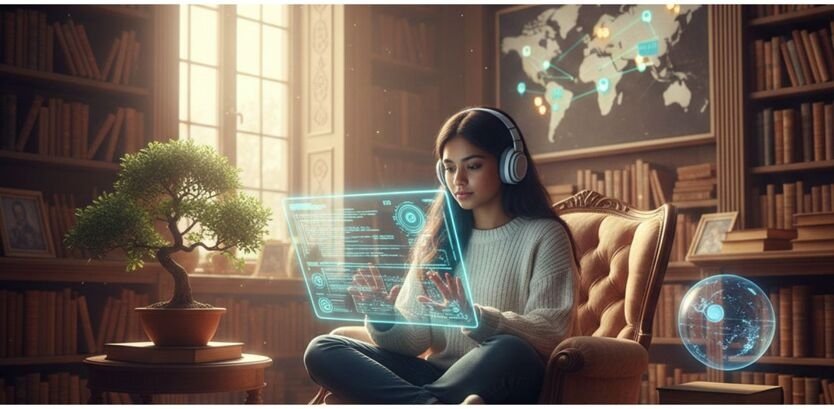
Imagine you are standing in front of a massive library where every book represents a different future. In the past, someone would hand you one specific book and tell you, “This is the only one you need to read.” But today, the world is moving too fast for just one book.
The most successful people in the world have a secret weapon: they don’t wait to be taught. They teach themselves. This is the core of self-learning importance. It is the process where you take the driver’s seat of your own education. Instead of just following a teacher’s lesson plan, you decide what to learn, how to learn it, and when to start.
Self-learning is an educational process where you rely on yourself to gather knowledge. It is flexible, exciting, and deeply personal. Whether you are watching a video to learn how to code, reading a book about history, or practicing a new language on an app, you are engaging in self-study.
In this guide, we will explore why this skill is the most valuable tool you can have in the 21st century.
“The biggest benefit of teaching yourself is the ability to master high paying jobs you can do from home without a degree. By focusing on the top 10 skills in demand for 2026, you ensure your career remains future-proof.”
The Importance of Self Regulation in Learning
To be a successful self-learner, you first need to understand the importance of self regulation in learning. Think of self-regulation like a thermostat for your brain. It helps you stay at the right “temperature” so you don’t get too frustrated or too bored.
Self-regulation is the ability to monitor and manage your energy, emotions, and thoughts. When you study by yourself, there is no bell ringing to tell you when to start or a teacher looking over your shoulder to make sure you are working. You have to be your own boss.
One big part of self-regulation is setting goals. If you say, “I want to learn everything about science,” you will likely give up because that goal is too big. A self-regulated learner breaks that down into: “Today, I will learn how plants breathe.”
Another part is emotional control. Sometimes, a topic is hard. You might feel like quitting. A student who understands self-regulation knows how to take a break, breathe, and try a different approach instead of throwing the book across the room.
Finally, self-regulation involves self-reflection. After a study session, you ask yourself, “Did I actually understand that? Or was I just staring at the page?” This honesty is what makes self-learning actually work.
Why Self Learning is Important
You might wonder, “If I’m already going to school, why self learning is important?” The answer lies in the world outside the classroom. School gives you a foundation, but self-learning gives you your edge.
First, the world is changing faster than any textbook can keep up with. New technologies like AI or green energy are evolving every day. If you only learn what is in your school curriculum, you might be learning things that are already outdated by the time you graduate.
Self-learning allows you to stay current. You can go online and take a course on the very latest trends. This makes you “future-proof.” You aren’t just waiting for information to be given to you; you are out there hunting for it.
Second, self-learning builds confidence. There is a special kind of “I can do anything” feeling that comes from teaching yourself a difficult skill. When you realize you can learn how to build a website or cook a complex meal just by researching it, you stop being afraid of new challenges.
Third, it allows for “Deep Learning.” In a classroom, the teacher has to move at a pace that works for 30 different students. With self-learning, if you love a topic, you can spend ten hours on it. If you already know something, you can skip it. It is the most efficient way to use your brain.
Self Learning Skills for Students
Becoming a great self-learner doesn’t happen overnight. It requires specific self learning skills for students to develop over time. If you can master these, school and life becomes much easier.
1. Curiosity and Questioning Everything starts with a “Why?” or a “How?” Instead of just accepting a fact, a self-learner asks more questions. Curiosity is the fuel that keeps you moving when the work gets tough.
2. Time Management Since you are in charge, you have to decide how to spend your minutes. Successful students often use the “Pomodoro Technique,” where they study for 25 minutes and then take a 5-minute break. This keeps the brain fresh.
3. Finding Reliable Resources Not everything on the internet is true. A key skill is learning how to tell a good source from a bad one. This means looking at who wrote the article and checking if other experts agree with them.
4. Note-Taking and Summarizing You haven’t really learned something until you can explain it in your own words. Writing summaries or drawing mind maps helps lock the information into your long-term memory.
5. Persistence You will hit walls. You will get confused. The skill of persistence is what separates someone who starts a project from someone who finishes it. It’s okay to be confused; it’s just a sign that your brain is growing.
Self Learning in Education
The role of self learning in education is changing how schools work. Many modern classrooms are moving toward a “flipped” model. In this setup, students learn the basic facts at home through videos or reading, and they use class time for projects and discussions.
This is important because it changes the teacher’s role. Instead of being a “sage on the stage” who just talks for an hour, the teacher becomes a coach. They help you navigate the information you found on your own.
Self-learning also helps bridge the gap between different types of learners. Some people are visual learners, while others learn better by listening or doing. In a traditional lecture, only one type of learner is usually being helped.
Through self-study, a student can choose the format that works best for them. If a textbook is boring, they can find a podcast. If a podcast is too fast, they can find an interactive simulation. This personalization makes education more inclusive for everyone.
Furthermore, self-learning encourages “interdisciplinary” thinking. This is a fancy way of saying you can connect different subjects. For example, you might be self-studying art and realize that the patterns you see are actually based on math. These connections happen more often when you are free to explore.
Advantages of Self Learning
There are many advantages of self learning that you won’t find in a standard classroom environment. These benefits stay with you for your entire life.
- You Learn at Your Own Pace: There is no pressure to “keep up” or “slow down” for others. You are the master of your own clock.
- It’s Stress-Free: Without the immediate pressure of a pop quiz or a teacher’s gaze, many students find they actually enjoy the topics more.
- Development of Problem-Solving Skills: When you learn alone, you have to figure things out. If a link doesn’t work or a concept is hard, you have to find a solution. This makes you a better problem solver in real life.
- Better Retention: Research shows that when you actively seek out information because you want to know it, you remember it much longer than if you were forced to memorize it for a test.
- Discovery of Passions: Self-learning lets you “sample” different topics. You might try learning about coding for a week and realize you hate it, but then try graphic design and realize you love it. This helps you choose a career you will actually enjoy.
How to Start Your Self-Learning Journey
If you want to start today, you don’t need much. Start by picking one thing you’ve always been curious about. It could be how to play chess, how engines work, or how to speak basic Japanese.
Dedicate just 20 minutes a day to this topic. Use YouTube, library books, or free websites like Khan Academy. The key is consistency.
Don’t worry about being perfect. The goal of self-learning isn’t to get an ‘A’; the goal is to grow. If you learn one new thing today that you didn’t know yesterday, you are winning.
FAQs
What is the main difference between self-learning and traditional learning? Traditional learning is usually led by a teacher with a set curriculum and timeline. Self-learning is led by the student, who chooses the materials, the pace, and the specific topics.
Can self-learning replace school? For most people, self-learning works best when it is combined with school. School provides the foundation and social interaction, while self-learning allows you to go deeper into your specific interests.
Is self-learning hard for younger students? It can be a challenge at first because it requires discipline. However, even 6th-grade students can practice self-learning by choosing a hobby and researching it for 15 minutes a day.
Do I need expensive tools to be a self-learner? Not at all! A library card and an internet connection are the most powerful tools in the world. Many of the best educational resources today are completely free.
Conclusion
The self learning importance cannot be overstated. We live in a world where the ability to learn is more important than what you already know. By taking charge of your education, you are building a bridge to a better future.
You are developing the self-regulation to stay focused, the skills to find answers, and the confidence to tackle any challenge. Remember, your education is not something that happens to you it is something you create.
Whether you are a student looking to get better grades or someone wanting to start a new career, the power to change is in your hands. So, what are you going to learn today?