
In a quiet coaching session recently, I spoke with a young mother training to be a radiologic technician. She was exhausted, juggling childcare with complex medical textbooks. She admitted, “I don’t really know how to study for this exam, though I did use ChatGPT, and it was helpful.” Her experience isn’t unique. Over the past month, during the first-ever ChatGPT Lab with students across the U.S., we discovered that students aren’t just using AI to “get answers” they are using it to think more deeply, move ideas forward, and build things they truly care about.
The old way of studying involved hours of passive reading, highlighting text until the page turned neon, and hoping the information stayed in your brain. But true learning happens through active engagement. Whether you are a 6th grader or a graduate student, learning how to use ChatGPT for exam preparation can transform those stressful, late-night cram sessions into organized, high-focus learning sprints.
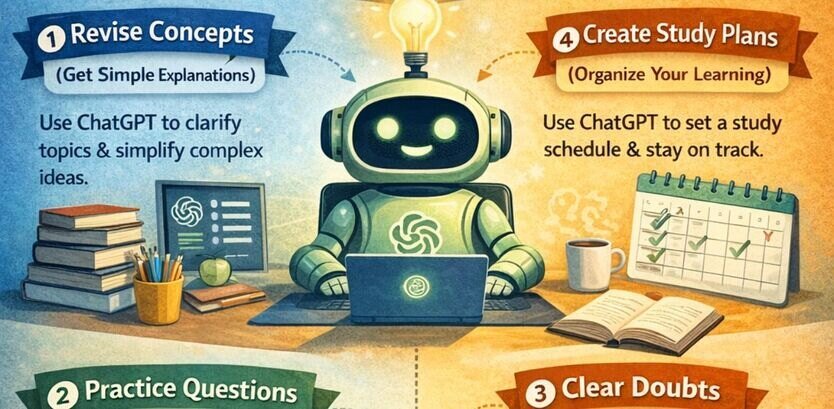
By using AI as a personal tutor, you can turn passive reading into an interactive dialogue. In this guide, we will explore how to leverage AI to simplify complex concepts, generate practice tests, and build a study schedule that actually works for your life.
How to Use ChatGPT to Study
Studying is more than just memorizing facts; it is about building a mental map of a subject. ChatGPT acts as a bridge between a confusing textbook and your understanding. One of the most effective ways to use it is for “Concept Breaking.”
If you are staring at a paragraph about photosynthesis or macroeconomic theory and your brain feels like a knotted string, ask ChatGPT to simplify it. You can use a prompt like, “Explain this concept like I am in 6th grade.” This forces the AI to strip away jargon and focus on the core logic. Once you understand the “why,” the “how” becomes much easier to memorize.
Another powerful method is the Feynman Technique. This involves explaining a topic to someone else to find gaps in your own knowledge. You can tell ChatGPT: “I am going to explain the causes of World War I to you. Listen to my explanation and tell me what details I missed or where my logic is weak.” This turns the AI into a sounding board that catches your mistakes before the examiner does.
Active recall is the gold standard of studying. Instead of reading your notes over and over, ask ChatGPT to quiz you. You can paste a page of your notes and say, “Based on these notes, ask me five challenging questions one by one. Don’t give me the answers until I respond.” This forces your brain to retrieve information, which strengthens the neural pathways associated with that memory.
How to Use ChatGPT for Online Exam Preparation
Preparing for an online exam requires a specific strategy, especially when exams are timed or involve unique formats like multiple-choice or short-essay responses. ChatGPT can help you simulate the digital environment you will face.
First, use the AI to practice time management. Many online exams fail students not because they don’t know the material, but because they run out of time. You can provide ChatGPT with a topic and ask it to “Generate three essay prompts. Give me 15 minutes to outline each one and then give me feedback on my structure.”
For online exams that focus on problem-solving, such as math or coding, ChatGPT can provide step-by-step breakdowns of logic. If you are stuck on a practice problem, don’t just ask for the answer. Ask, “Walk me through the logic of this problem without giving me the final answer yet.” This ensures you are learning the process, which is what online exams usually test.
Additionally, ChatGPT can help you prepare for “open book” online exams. These exams are often harder because they require higher-level synthesis rather than rote memory. Use the AI to create a digital index or a summary of your materials. Ask it to “Summarize the key arguments from these three chapters and show how they relate to one another.” This helps you navigate your resources quickly during the actual test.
Best ChatGPT Prompts for Students
To get the most out of AI, you need to know how to “prompt” it. Think of a prompt as a set of instructions for your personal tutor. The more specific you are, the better the help you will receive.
For Summarization: “I have a 1,500-word article on the Industrial Revolution. Please provide a summary in five bullet points focusing on the social impacts on children and families.”
For Vocabulary Building: “I am studying for my English Literature exam. Give me a list of 10 advanced vocabulary words related to ‘Tragedy’ and use each in a sentence that a 6th grader would understand.”
For Critical Thinking: “I am writing an essay about why the Roman Empire fell. Give me three counter-arguments to the idea that it was purely due to military failure.”
For Memory Aids: “Create a catchy mnemonic device to help me remember the order of the planets in our solar system.”
For Roleplay Learning: “Act as a historical expert on the Civil Rights Movement. I will interview you about the Montgomery Bus Boycott. Answer my questions with historical facts and personal anecdotes that a person at that time might have felt.”
ChatGPT Study Schedule Generator
One of the biggest hurdles in exam prep is the “Where do I start?” feeling. When you have three weeks until finals and five subjects to cover, it feels overwhelming. ChatGPT is an incredible tool for organizing your time based on your specific strengths and weaknesses.
To create a personalized schedule, give the AI as much context as possible. Tell it your exam dates, which subjects you find hardest, and what time of day you have the most energy. For example: “I have exams in Math, History, and Science in two weeks. I am great at Math but struggle with History dates. I can study for 3 hours every evening. Create a 14-day study plan that uses ‘spaced repetition’ and focuses more on History.”
The AI can then break your study sessions into manageable chunks, often recommending the Pomodoro Technique (25 minutes of focus followed by a 5-minute break). It can even suggest which specific topics to cover each day so you don’t spend too much time on one area.
If your schedule changes perhaps you have a family event or you get sick you don’t have to rewrite the whole plan. Just tell ChatGPT: “I missed my study sessions on Tuesday and Wednesday. Please recalibrate my 14-day plan to make up for that lost time without burning me out.”
AI Prompts for Exam Revision
Revision is the phase where you move from “learning” to “mastering.” During this stage, you want to use AI to find the “weak links” in your knowledge.
A great revision prompt is the “Edge Case” prompt. You can ask: “I understand the basic laws of physics regarding motion. What are some common mistakes students make when applying these laws to friction problems?” By knowing where others fail, you can avoid those same traps.
You can also use AI to condense your notes for “Quick Review” sheets. Paste a large section of text and ask: “Turn this into a one-page cheat sheet with the most important dates, formulas, and names.” These are perfect for reviewing right before you head into the exam room.
If you are studying a foreign language, use revision prompts like: “Translate this paragraph into Spanish, then point out the three most difficult grammatical structures used and explain why they were used there.” This deep-dive approach ensures you aren’t just memorizing phrases but understanding the underlying rules of the language.
ChatGPT for Mock Test Generation
The best way to reduce exam anxiety is to see the “ghost” of the exam before it happens. Mock tests are essential for building confidence. ChatGPT can generate these in seconds.
You can specify the format of the test. Do you need multiple-choice, true/false, or long-form essays? You can say: “Create a 10-question multiple-choice quiz on the human circulatory system. Include two ‘distractor’ answers for each question that look correct but are actually wrong.”
Once you finish the mock test, you can feed your answers back to ChatGPT for grading. Ask it: “Here are my answers to the quiz. Grade them and tell me not just what I got wrong, but why the correct answer is right.” This immediate feedback loop is something a traditional textbook can never provide.
You can even ask it to mimic the style of a specific board or exam type. For example, “Generate a mock test for the AP Biology exam focusing on genetics. Use the same tone and difficulty level as official College Board practice questions.”
Practical Takeaways for Using AI in Education
As you integrate ChatGPT into your study routine, keep these actionable tips in mind to ensure you are using the tool effectively and ethically:
Check for Hallucinations: AI can occasionally be “confidentially wrong.” Always double-check important dates or complex formulas against your primary textbook. Use ChatGPT to explain the logic, but use your class materials as the final source of truth.
Stay Active, Not Passive: Don’t just ask ChatGPT to write your notes for you. The learning happens when you interact with the information. Use the AI to challenge you, quiz you, and debate you.
The Power of “Why”: Whenever the AI gives you an answer, follow up with “Why is that the case?” This helps move the information from short-term memory into long-term understanding.
Combine with Analog Tools: Try using ChatGPT to generate a summary, then write that summary out by hand. Research shows that the physical act of writing helps with memory retention much more than typing or reading on a screen.
Frequently Asked Questions
Is using ChatGPT for exam prep considered cheating?
Using ChatGPT to understand concepts, create study schedules, or generate practice questions is a powerful learning aid, similar to hiring a tutor or using a study guide. However, using it to generate answers during a live exam or to write an essay that you turn in as your own work is considered academic dishonesty. Always check your school’s specific AI policy.
Can ChatGPT help with math problems
Yes, but it is best used for explaining the steps. Instead of asking for the final number, ask: “Can you show me the steps to solve this quadratic equation?” This helps you learn the method so you can do it yourself during the test.
How do I know if the information from ChatGPT is accurate?
ChatGPT is trained on a vast amount of data, but it isn’t perfect. It is most reliable for well-established subjects like history, basic science, and language. For very recent events or niche technical data, always verify the facts with a reliable secondary source.
Can I use ChatGPT to summarize my textbooks?
Yes! You can take pictures of your textbook pages (using the mobile app) or paste text into the chat. Ask it to “summarize the main points” or “create a list of key terms” to save time on note-taking.
Conclusion
The journey of education is often paved with stress and late nights, but tools like ChatGPT are changing the landscape. By shifting from passive consumption to active, AI-assisted engagement, you can reclaim your time and boost your confidence. Whether you are a student in the ChatGPT Lab or a busy parent returning to school, the key to success lies in how you use the tools at your disposal.
Using ChatGPT for exam preparation isn’t about finding a shortcut; it’s about finding a smarter way to learn. It turns a static textbook into a living conversation. It takes the “fear of the unknown” out of exams by allowing you to practice in a safe, controlled environment.
As you prepare for your next big test, remember that the goal of studying is to truly understand the world around you. Use these prompts, build your schedules, and take those mock tests. You have the tools to perform with confidence.