
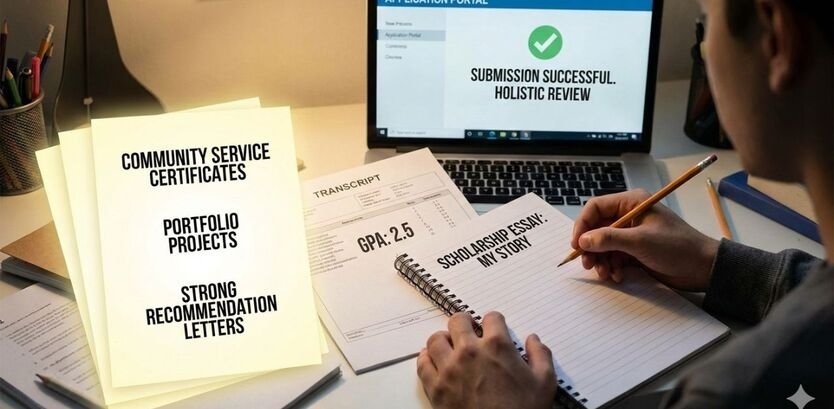
Think a low GPA is a scholarship death sentence? Think again. While the ‘straight-A’ crowd is busy fighting over the same five academic awards, thousands of dollars in funding go unclaimed every year because students with average marks simply don’t apply. The truth is, scholarship committees aren’t just looking for human calculators they are looking for impact, resilience, and a story worth investing in. If you know how to shift the spotlight from your transcript to your unique potential, you can outmaneuver the honors roll and secure the bag. Here is exactly how to stop apologizing for your grades and start winning the scholarship game.
Low marks do not mean the end of your scholarship journey. Committees look beyond GPA your personal story, community work, upward grade trend, strong recommendations, and skills all count. This guide shows you exactly how to turn your weaknesses into a winning application.
Why Low Marks Are Not the End of Your Scholarship Journey
Every year, millions of students skip scholarship applications because they assume their grades will get them rejected automatically. That assumption costs them thousands of dollars in funding they actually qualified for.
Here is the reality: scholarship committees are not just looking for straight-A students. Many programs are specifically designed for students who have faced challenges financial hardship, family problems, health issues, or simply a different kind of intelligence that a grade sheet cannot measure.
A student with a 2.4 GPA who spent three years volunteering at a hospital, learned a new language, and can write a compelling personal story has a very real shot at beating a student with a 3.8 GPA who has nothing else to show.
This guide is not going to give you the same recycled advice you have already read. It will show you the exact strategies that work from how to write a grade explanation letter, to how scholarship committees actually make decisions, to how to apply to 80+ scholarships without burning out.
What Scholarship Committees Actually Look At (Most Articles Do Not Tell You This)
Most articles say “scholarships look at the whole person.” But what does that actually mean? Here is a more specific breakdown of how committees evaluate applications when a student does not have strong marks.
Scholarship reviewers typically score applications across multiple categories. Academic performance is one category but it usually carries only 20 to 40 percent of the total weight in holistic programs. The rest comes from your essay, recommendation letters, extracurriculars, financial need, community impact, and clarity of goals.
Many committees also use a “compensatory model” meaning a very strong score in one area can make up for a weak score in another. A student with a 2.5 GPA who writes an extraordinary essay can outscore a student with a 3.6 GPA who writes a generic one.
What actually gets flagged as a red flag: Not having low grades but having no story to tell. Committees are more concerned about students who show no direction, no passion, and no self-awareness. A student who can explain why their grades were low AND what they learned from it actually earns respect from reviewers.
The bottom line: know which scholarships use a compensatory model (most need-based and essay-based ones do), and build your application to score maximum points in the areas you are strong in.
Which Type of Scholarship Should You Actually Apply For?
Not all scholarships weight GPA the same way. Before you apply anywhere, understand which category fits your situation. This comparison missing from almost every competitor article will save you hours of wasted applications.
| Scholarship Type | GPA Needed | What They Look For | Your Chance |
|---|---|---|---|
| Merit-Based | 3.5 – 4.0 | Academic excellence only | Low if GPA < 3.0 |
| Need-Based | 2.0 – 2.5 | Financial situation, goals | High |
| Talent-Based | No minimum often | Art, music, sports, tech | High |
| Community Service | 2.0+ | Volunteer hours, leadership | High |
| Essay-Based | None usually | Writing skill, story, vision | Very High |
| Identity/Background | 2.0 or none | Heritage, first-gen, location | High |
The safest strategy for a student with low marks is to focus primarily on need-based, essay-based, and talent or skill-based scholarships. These give you the highest chance of success regardless of your GPA.
Merit-based scholarships with a GPA cutoff above 3.0 are largely a waste of your time unless you have extraordinary achievements in other areas. Local and community scholarships are also highly underrated they receive far fewer applications, which means your odds are much better even with lower grades.
How to Write a Grade Explanation Letter (The Tool Most Students Never Use)
This is one of the most powerful tools in your scholarship toolkit and it is almost never mentioned by other guides.
A grade explanation letter (also called a GPA addendum) is a short, additional document you include with your application that addresses your low grades directly, honestly, and strategically. Many scholarship programs allow and actually appreciate this kind of transparency.
When Should You Write One?
- Your grades dropped significantly during one or two specific semesters
- You were dealing with a serious personal situation such as illness, family crisis, financial stress, or mental health challenges
- Your GPA does not reflect your actual knowledge or capability in your field
- You have shown a clear upward trend since the low-grade period
What to Include in the Letter
- A brief, factual explanation of what happened no dramatizing, no excuses
- What you did to overcome the situation
- Specific evidence of improvement such as course grades, certifications, or projects
- A clear statement about your goals and why you are ready now
What NOT to Write
- Do not blame professors or the education system
- Do not say grades “don’t matter” committees will dismiss this immediately
- Do not be vague: “I was going through personal issues” tells them nothing useful
- Do not make it longer than one page
A sample opening might look like this: “During my second year, my grades declined significantly because I was working 30 hours per week to support my family after my father’s illness. Despite this, I completed the semester, improved my study methods, and raised my GPA by 0.7 points in the following year.”
This kind of statement is honest, specific, and forward-looking exactly what reviewers want to see.
Build an Upward Grade Trend Improvement Counts More Than You Think
Scholarship committees understand that life is not linear. What they look for is not a perfect past it is a student who shows growth.
If your marks improved over time even slightly that trend is your biggest asset. A student who went from a 2.0 in year one to a 3.2 in year three shows resilience, maturity, and work ethic. Many committees will actually rate this student higher than someone who had a steady 3.0 the whole time.
If you still have time before applying, be strategic about your course selection. Taking a slightly heavier load in subjects you are strong in, or completing an extra course in your field of interest, can demonstrate seriousness. Even a short online certification course with a strong grade can be mentioned as evidence of your capability.
Key tactic: In your application essay, reference the upward trend explicitly. Say something like: “My GPA in year one does not reflect my abilities. What it reflects is a difficult period I worked hard to overcome. By my final semester, my grades in my core subjects were among the top in the class.”
How to Get Strong Recommendation Letters When Your Grades Are Low
A strong recommendation letter can genuinely overcome a weak transcript. But most students make the mistake of asking a professor who barely knows them, or not briefing the letter writer properly.
Choose the Right Person
- Pick a professor or mentor who has seen your non-academic qualities your effort, curiosity, leadership, or problem-solving ability
- A workplace supervisor, volunteer coordinator, or community leader can be just as powerful as a professor
- Avoid choosing someone just because they gave you a good grade choose someone who actually knows who you are
Have an Honest Conversation With Your Recommender
This is the step most students skip. Before your recommender writes the letter, sit down with them and be honest. Say something like: “My GPA is not strong, and I want this letter to help show the committee things the transcript cannot show. Can you speak to my work ethic, how I approached problems, or what I contributed beyond my grades?”
A good recommender who is briefed properly will focus on your resilience, your curiosity, your real-world skills, and your character. These qualities often matter more to reviewers than any single grade.
Give Your Recommender the Right Information
- A brief summary of the scholarship and what it values
- Two or three specific stories or moments that showcase your strengths
- Your goals and why this scholarship matters to you
- The deadline at least three to four weeks in advance
Writing a Scholarship Essay That Wins Without Good Grades
The personal essay is where you win or lose a scholarship when your GPA is not your strongest asset. Most students write essays that are either too generic, too focused on listing achievements, or too emotional without substance.
The Story Framework That Actually Works
Committees read hundreds of essays. What makes one stand out is a real story with a clear arc: here is where I was, here is what happened, here is what I learned, and here is where I am going.
Your essay does not need to be about your low grades. But if grades are mentioned at all, frame them as part of your growth not your identity. The strongest essays are about a genuine challenge, a specific turning point, and a clear vision for the future.
Common Mistakes That Cost Students the Scholarship
- Starting with “I have always been passionate about…” this phrase appears in hundreds of essays and signals nothing
- Being vague about goals: “I want to help people” is not a goal; “I want to build low-cost diagnostic tools for rural clinics” is
- Spending too much time on the problem and not enough on what you did about it
- Not connecting your story to why this specific scholarship matters to you
- Using AI-generated language that sounds flat and impersonal committees notice
The One Question Every Essay Should Answer
Before you submit any essay, ask yourself: if someone reads this and never sees my grades, do they walk away thinking this person is driven, self-aware, and ready? If yes, your essay is working.
Skills, Certifications, and Extracurriculars That Can Replace GPA on Your Application
This is an area most guides barely touch. Outside of academic performance, there are concrete achievements you can build and highlight that significantly boost your scholarship application.
Certifications That Add Weight
- Google, Coursera, or LinkedIn Learning certificates in your field of study
- Technical certifications like AWS, HubSpot, Adobe, or Microsoft Office Specialist
- Language proficiency tests such as IELTS, TOEFL, DELF, or JLPT
- Red Cross first aid or community health training certificates
- Local trade or vocational program completions
Even a free online course completed with strong assessment scores can be listed as evidence of academic capability that your transcript does not show.
Extracurriculars That Count More Than Most Students Think
- Consistent volunteer work especially if you held any kind of leadership role
- Starting a small project, initiative, or online venture even informal ones count
- Participation in sports, arts, or debate committees value well-rounded students
- Caring for a sick family member or working to financially support your family shows maturity
- Social media content creation in your field shows initiative and communication skills
The key is to frame these activities in terms of what you contributed and what you learned not just to list them. A scholarship reviewer wants to see that your extracurriculars show character, not just a busy schedule.
How to Apply to 80+ Scholarships Without Burning Out
One of the most underrated strategies for students with low marks is sheer volume. The more scholarships you apply to, the higher your odds. But most students apply to five and give up after three rejections.
Felecia Hatcher, author of The C-Student’s Guide to Scholarships, submitted 300 applications and won $130,000 in scholarships with a low GPA. The strategy was not luck it was volume with a smart system.
The Application Template System
- Write three strong essay templates: one focused on your personal story, one on your goals, one on your community impact
- Each template should be 80 percent complete leaving 20 percent to customize per scholarship
- Keep a master document with all your achievements, dates, organizations, and specific examples
- Build a recommendation letter package that your letter writers can adapt quickly
Where to Track Your Applications
- Use a simple spreadsheet: scholarship name, deadline, requirements, status, essay used
- Set a weekly goal even five applications per week adds up to over 200 in a year
- Apply to local scholarships first these have fewer applicants and your odds are dramatically better
What Platforms to Use
- Scholarships360.org filter by minimum GPA and find 2.0+ options
- Bold.org large database with no-GPA and low-GPA specific scholarships
- Fastweb.com matches you with scholarships based on your profile
- GoingMerry.com allows quick-apply to multiple scholarships from one profile
- Your university or college financial aid office often has internal scholarships rarely advertised publicly
- Local chambers of commerce, community foundations, religious organizations, and employers of your parents
What NOT to Do in Your Scholarship Application
Knowing what to avoid is just as important as knowing what to do. These are the mistakes that cost students their scholarships especially students who are already working against a weak transcript.
Do not apologize for your grades in your essay. There is a difference between explaining and apologizing. Explaining shows self-awareness. Apologizing shows insecurity. Committees are investing in your future, not judging your past.
Do not exaggerate or invent achievements. Scholarship programs verify information. Listing a club you attended twice as a leadership role, or inflating volunteer hours, can disqualify you entirely and some programs notify your institution.
Do not apply to scholarships you are clearly ineligible for. If the minimum GPA is 3.5 and yours is 2.3, move on. Spending time on guaranteed rejections wastes energy you need for scholarships you can actually win.
Do not submit the same generic essay everywhere. A scholarship for engineering students should feel different from one for community activists even if your core story is the same. One sentence of customization matters more than you think.
Do not ignore small scholarships. A $500 scholarship feels insignificant, but fifty of them add up to $25,000. Many students ignore small awards and then complain there is no money available. Small scholarships are often the easiest to win.
Do not wait until the last minute. Late applications are automatically rejected. Early submissions also get reviewed more carefully many committees finish review before the deadline officially closes.
International Students With Low GPA Extra Tips
For international students, the challenge is double: not only do you have lower marks, but you are competing across borders in a different educational system.
- Get your GPA officially converted to the target country’s grading scale a 2.8 on one system may equal a 3.4 on another
- Look for scholarships designed specifically for students from your country or region these have fewer applicants
- Erasmus Mundus, some Commonwealth Scholarships, and several European university programs consider research potential and English proficiency above GPA
- A strong IELTS or TOEFL score of 7.0 or above signals academic capability and directly compensates for transcript weaknesses in many programs
- Letters from professors at your home institution carry special weight for international applications brief them properly
- Consider scholarships offered by NGOs, cultural organizations, and bilateral programs between your country and the target country
Conclusion
If your grades are not where you wanted them to be, you have two choices. You can let that be the story or you can make sure your application tells a bigger one.
Scholarship committees are made up of real people who have seen thousands of applications. They know that life is not always fair, that intelligence takes many forms, and that a grade sheet captures only a fraction of who a student really is. What they are looking for is someone who is honest about where they have been, clear about where they are going, and determined enough to make the case for themselves.
That case starts with understanding the system knowing which scholarships suit your profile, building every other part of your application as strongly as possible, writing a grade explanation letter if your situation warrants it, and applying broadly with a smart, reusable system.
Your grades are not your ceiling. They are just one data point in a story you still get to write.
Frequently Asked Questions (FAQs)
Q1: Can I get a scholarship with a 2.0 GPA?
Yes. Many scholarships accept students with a 2.0 GPA or lower, particularly need-based programs, talent-based awards, and essay competitions. The key is to target scholarships that do not use GPA as a primary filter and to make every other part of your application as strong as possible.
Q2: Should I mention my low grades in my personal essay?
Only if you have a clear, specific story to tell about them. Do not mention grades just to apologize that wastes valuable essay space. If you can explain the grades in a way that shows growth and self-awareness, briefly addressing them can actually strengthen your application. If you cannot, leave it out and focus on your strengths instead.
Q3: What is a grade explanation letter and do I have to write one?
A grade explanation letter is an optional document where you briefly explain the circumstances behind low marks. You do not always have to write one, but if your grades dropped significantly during a specific period due to a legitimate reason, this letter can change how a committee reads your application. Keep it factual, brief, and forward-looking.
Q4: How many scholarships should I apply for?
There is no fixed number, but applying to at least 30 to 50 scholarships significantly increases your chances. Students who treat scholarship applications like a part-time job applying consistently, building reusable materials, and targeting the right programs regularly win multiple awards even with low GPAs.
Q5: Are local scholarships worth applying for?
Local scholarships are among the most underutilized opportunities available. They receive far fewer applications than national scholarships, the GPA requirements are often lower or nonexistent, and committees value community connection. Check with your local chamber of commerce, community foundation, religious organizations, and your parents’ employers.
Q6: My grades are low because of mental health struggles. Should I mention this?
This is a personal decision. If your mental health affected your performance in a documented way and you are in a better position now, briefly mentioning it in a grade explanation letter can provide important context. Be factual and solution-focused describe what support you sought, how you recovered, and what you are doing differently now.
Q7: Can online certifications actually help my scholarship application?
Yes, especially for scholarships in technology, business, design, or vocational fields. A Google Career Certificate, a HubSpot certification, or a completed Coursera specialization shows initiative and capability that your transcript may not. List certifications clearly, mention the skills you gained, and connect them directly to your goals.
Q8: Is it possible to win a scholarship if I never did any volunteer work or extracurriculars?
It is harder, but not impossible. Essay-based scholarships, need-based awards, and some identity-specific scholarships focus very little on extracurriculars. If you are in this position, prioritize writing an outstanding personal essay, securing strong recommendation letters that speak to your character, and applying heavily to need-based programs.