
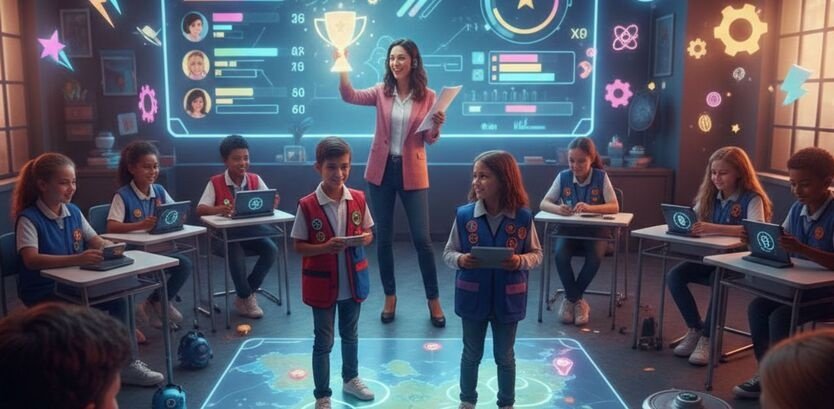
In the past, classroom learning was sitting quietly and taking notes, but researchers and educators now recognize that this approach often falls short, especially when it comes to sparking student engagement and motivation.
As a result, more and more schools and training companies are leveraging the power of gamification in education. Understanding what gamification is and how it can enhance the learning experience will help you create a more effective and engaging environment for your students.
In the business world, gamification is used in customer loyalty programs for credit cards and memberships: Spend money and invest time in the business’s app and products to earn discounts and status upgrades. Everyone benefits at their own pace.
This same psychological approach using game mechanics to drive real-world behaviors is revolutionizing how students learn, retain information, and develop critical thinking skills. It’s an approach that taps directly into the natural human desire for achievement, recognition, and mastery.
The Concept of Gamification in Education: More Than Just Games
The first step in leveraging this powerful strategy is clearly defining it. What exactly is the concept of gamification in education?
At its core, gamification is the application of typical elements of game playing (such as point scoring, competition, and rules of play) to non-game contexts, specifically learning environments.
It is crucial to understand that gamification is distinct from Game-Based Learning (GBL).
- Gamification: Applying game mechanics (like points, badges, leaderboards) to existing learning content or structures. The content itself is not a game. For instance, awarding “XP” for completing homework.
- Game-Based Learning (GBL): Using actual games (either digital or physical) to teach specific content or skills. For example, using Minecraft Education Edition to teach city planning or using a history-themed board game to understand a political conflict.
Gamification uses the psychological drive that makes games so compelling to enhance instructional design. It is rooted in behavioral psychology, aiming to fulfill core psychological needs such as competence (feeling successful), autonomy (having choices), and relatedness (feeling connected to others).
Key Principles of Gamified Learning Design
Successful gamification hinges on integrating specific elements that mimic a game experience:
- Defined Goals and Rules: Clear learning objectives must translate into clear game goals, so students know exactly what they are working toward (e.g., reaching Level 5 or earning the “Master Historian” badge).
- Reward Systems (Points and Badges): These provide instant, visible feedback on progress and mastery.
- Progression and Leveling Up: Students move through a defined curriculum path, often structured into “levels” or “quests,” which gives a strong sense of advancement.
- Narrative/Storytelling: Contextualizing learning within a theme or story (e.g., “saving the planet,” “solving a historical mystery”) makes the content more memorable and immersive.
- Feedback Loops: Providing immediate and continuous feedback, allowing students to learn from mistakes instantly rather than waiting for a graded assignment days later.
By implementing these principles, educators transform passive consumption of material into an active, motivating journey.
Benefits of Gamification in Education: Igniting the Spark of Learning
The shift to a gamified classroom yields measurable positive outcomes for both students and educators. When properly implemented, the benefits of gamification in education go far beyond simply making lessons “more fun.”
1. Increased Student Engagement and Motivation
Traditional lectures often struggle to capture the attention of digital-native students. Gamification, however, leverages students’ familiarity with video game structures to grab and hold their focus.
- Intrinsic Motivation: The strongest benefit is the cultivation of intrinsic motivation the desire to do something for the sheer enjoyment of the activity itself. Challenges, mystery, and the pursuit of mastery inherent in games satisfy this drive.
- Active Participation: Students are more willing to participate when they see their efforts immediately reflected in points or progress. This turns reluctant learners into proactive participants who are ready to take risks without the fear of failure.
2. Enhanced Retention and Deeper Understanding
Learning in a gamified context is often experiential. When students apply knowledge in a challenging, scenario-based context, the information sticks better.
- Learning Through Failure: In a game, failure is not an end; it’s a necessary part of the process. Gamified systems encourage repeated attempts without the typical stress of academic failure, solidifying the idea that mistakes are opportunities for growth.
- Immediate Feedback: Real-time feedback loops allow students to correct misconceptions immediately, preventing bad habits from forming and leading to a much richer and more fruitful learning experience.
3. Support for Personalized Learning Paths
One of the great challenges in education is addressing diverse learning speeds and styles. Gamification provides an elegant solution by naturally accommodating individual pacing.
- Self-Paced Progression: Like advancing through levels in a video game, students can move ahead when they demonstrate mastery or take extra time and attempt optional “side quests” for extra practice. This ensures no student is held back or left behind.
- Choice and Autonomy: Offering students choices in their assignments such as selecting which challenge to attempt next or which badge to pursue—fulfills the need for autonomy, a key component of the Self-Determination Theory (SDT), leading to greater investment in the learning journey.
4. Cultivation of Critical 21st-Century Skills
Gamified challenges often require students to approach problems creatively, collaboratively, and systematically.
- Problem-Solving: Completing complex “quests” requires synthesizing information from multiple sources and applying critical thinking, mirroring the problem-solving required in real-world professional environments.
- Collaboration and Social Interaction: Many gamified setups, particularly those using team-based leaderboards or shared missions, encourage peer-to-peer teaching, group communication, and social learning, fostering crucial collaboration skills.
Gamification Techniques for Student Engagement: Tools of the Trade
The successful implementation of gamification relies on a strategic selection and deployment of various game elements. These gamification techniques for student engagement are the specific mechanisms that turn a routine lesson into an interactive experience.
1. Points, Badges, and Leaderboards (PBL)
The most common set of gamification mechanics, PBL provides a framework for tracking and celebrating achievement.
- Points (XP): Points, often referred to as “Experience Points” (XP), quantify effort and achievement. They can be awarded for any positive learning behavior, from answering a question correctly to submitting an assignment early or providing helpful peer feedback.
- Practical Takeaway: Use XP not just for correctness, but for effort, participation, and improvement. This rewards the process, not just the outcome.
- Badges: Badges are virtual or physical representations of mastery or skill acquisition. They are digital accolades awarded when a student hits a specific milestone or demonstrates a particular skill.
- Practical Takeaway: Design badges to represent skills that matter. Examples include “Critical Thinker,” “Vocabulary Veteran,” or “Collaborative Champion.”
- Leaderboards: Leaderboards tap into friendly competition and the human desire for recognition. They show the ranking of students or teams based on their accumulated points or progress.
- Cautionary Note: While powerful, leaderboards can be demotivating for students at the bottom. Consider anonymous leaderboards, team-based rankings, or focus on showing individual progress over time rather than pure rank.
2. Structuring Content with Quests, Levels, and Missions
Instead of chapters or units, framing the curriculum as a series of levels or quests creates a powerful narrative structure.
- Quest-Based Learning: Each unit of study becomes a “Quest” with a clear goal. Mandatory assignments are “Main Quests,” while supplementary or remedial work can be “Side Quests.”
- Leveling Up: A student “levels up” when they demonstrate mastery of a required body of knowledge (e.g., passing a unit assessment or completing a set of required tasks). Leveling up can unlock access to the next, more challenging content, giving a tangible sense of progression.
3. Implementing Storytelling and Themes
Integrating a narrative or theme makes the learning experience cohesive and memorable. The narrative provides the “why” behind the points and badges.
- Thematic Design: In a science class, the theme might be “Saving the Global Ecosystem,” where assignments are “research missions” and passing grades are “resource donations.” In history, the class might be “Time Travelers” solving historical anomalies.
- Immersive Scenarios: Tools like digital escape rooms or interactive simulations immerse students in realistic environments where they must apply concepts immediately to solve a problem.
4. Leveraging Digital Tools and Technologies
Modern technology has made gamification accessible for almost every educator.
- Interactive Quiz Platforms: Tools like Kahoot!, Gimkit, and Quizizz turn review sessions into competitive games with immediate scoring and ranking.
- Learning Management Systems (LMS) Integration: Many LMS platforms now have built-in gamification features, allowing teachers to easily assign badges, track progress, and use virtual currency for class rewards.
- Advanced Applications: Interactive simulations, often leveraging virtual reality (VR) or augmented reality (AR), can immerse students in complex subjects, such as conducting a virtual chemistry experiment or exploring historical sites.
The Use of Gamification in Education: Real-World Applications
The use of gamification in education is highly versatile, proving effective across all age groups, subjects, and environments, from primary school to professional development. The adaptability of game mechanics allows them to enhance almost any curriculum.
In Primary and Secondary Education (K-12)
Gamification here primarily focuses on boosting foundational skills, daily participation, and classroom management.
- Mathematics: Transforming math drills into speed challenges, where students earn points for quick, accurate responses. Teachers can use class economy systems where students earn virtual currency for good behavior and mastery, which they can “spend” on class privileges.
- Language Arts/Vocabulary: Creating word-of-the-day “challenges” where students earn badges for creative use of new vocabulary in their writing or speech. Digital scavenger hunts can be used to analyze texts for specific literary devices.
- Classroom Management: Behavioral management can be gamified by awarding team points for organizational skills, transitioning quietly between activities, or helping peers. This promotes a positive, cooperative class culture.
In Higher Education and University Settings
In higher education, gamification shifts towards encouraging complex analysis, deep engagement, and preparation for real-world scenarios.
- Engineering and Science: Using complex, multi-stage simulations where students must solve design flaws or research problems under realistic constraints. A study in Athens, Greece, demonstrated significant performance improvements among engineering students who engaged in gamified learning modules compared to those in traditional lecture-based settings.
- Interdisciplinary Courses: Designing semester-long, narrative-driven projects where students form “companies” or “research teams” to tackle a major challenge, earning points based on the quality of their deliverables and strategic decisions.
In Corporate and Professional Training
The effectiveness of gamification extends powerfully into the professional realm, serving as a model for how educational institutions can frame learning for career readiness.
- Skill Acquisition: Companies like Microsoft have seen success using gamified systems to train customer service agents, reporting a decrease in absenteeism and a sharp increase in knowledge application. Employees earn status and rewards based on completing training modules and achieving performance metrics.
- Onboarding: New employee orientation can be structured as a series of “onboarding quests” that must be completed to unlock new roles or access to systems, ensuring compliance and rapid knowledge integration in a structured, engaging way.
How to Implement Gamification in Education: A Step-by-Step Guide
Successfully integrating game elements requires thoughtful design that aligns with pedagogical goals. Here is a practical guide on how to implement gamification in education effectively.
Step 1: Define Your Learning Objectives (Start with the ‘Why’)
Before choosing a single badge or point system, determine what skills or knowledge students must acquire. Use the backward design approach:
- Identify Desired Results: What specific competencies must students master? (e.g., “Students must be able to write a persuasive essay.”)
- Determine Acceptable Evidence: What evidence will prove mastery? (e.g., A submission that meets specific criteria on a rubric.)
- Design the Learning Experiences (The Game): The game mechanics should logically lead students toward producing that evidence.
- Actionable Advice: Your game structure must support mastery. If a student can earn a high rank by completing easy tasks but avoids the core complex concepts, the game is flawed.
Step 2: Choose and Design Your Game Mechanics
Select elements that directly motivate your target audience. A high school class may respond well to competitive leaderboards, while a primary class might be more engaged by a visual points system tied to a class reward.
- Map Mechanics to Outcomes:
- Need for speed/mastery? Use timers and high-score boards (e.g., quick review quizzes).
- Need for sustained effort? Use levels and progress bars (e.g., completing a lengthy research project).
- Need for soft skills? Use special badges for collaboration, helping others, or creativity.
Step 3: Craft a Compelling Narrative and Theme
A strong narrative gives the learning purpose and makes the content more memorable.
- Establish the World: Give the class or the LMS a title (e.g., “The Academy of Ancient Wonders,” or “Future CEO Training”).
- Define the Stake: What is the overarching mission? Students are not just writing a paper; they are “unearthing a forgotten truth” or “solving a modern global crisis.”
Step 4: Balance Challenge with Reward and Rigor
The game must feel challenging enough to be engaging but not so difficult that it leads to frustration. This is the sweet spot known as the “flow state.”
- Maintain Educational Rigor: Ensure the core learning material is not oversimplified to fit the game structure. The game should enhance the material, not replace its intellectual complexity.
- Failure Must Be Low-Stakes: Provide ways for students to “retry” or “buy back” missed opportunities using virtual currency earned from success. This encourages risk-taking without long-term grade repercussions.
Step 5: Prioritize Feedback and Data Analytics
Gamified platforms generate vast amounts of data on time spent, attempts made, and common failure points.
- Use Data for Instruction: Analyze where students are getting stuck. Is everyone failing Quest 3? That signals a need for a re-teaching session or revised material, not just more points.
- Provide Instant Feedback: Use automated scoring for low-stakes practice to give students immediate insights, freeing up the educator to provide personalized coaching on complex assignments.
Step 6: Address Equity and Accessibility
Gamification often requires technology, which can introduce barriers.
- Ensure Universal Access: If digital platforms are used, provide students with the necessary hardware and reliable internet access during school hours.
- Offer Analog Alternatives: Provide non-digital ways to earn points or badges (e.g., a physical progress chart, paper-based challenges) to ensure inclusivity for all learners and learning styles.
Overcoming Challenges and Maintaining Intrinsic Motivation
While the transformative power of gamification is clear, educators must be mindful of potential pitfalls to ensure the approach remains beneficial and ethical.
The Risk of Overemphasis on Extrinsic Rewards
One of the primary concerns is the “overjustification effect,” where a student who initially loves a subject (intrinsic motivation) begins to focus only on the points or badges (extrinsic motivation).
- Strategy: Frame rewards as recognition of mastery, not the reason for the activity. Emphasize the narrative, the challenge, and the growth experienced, not just the final score. Use badges to celebrate the process (e.g., resilience, creativity) as much as the outcome.
Managing Competition and Stress
While competition drives engagement for many, it can be a source of stress and anxiety for others, especially if they consistently rank low.
- Strategy: Implement team-based competition where success relies on collective effort. Also, encourage “competition with self,” focusing on personal bests and achieving individual mastery targets. Provide non-competitive pathways to success.
The Importance of Proper Implementation and Training
A poorly designed gamified system is worse than none at all. If the game mechanics are convoluted or if they distract from the core curriculum, the effort will fail.
- Strategy: Start small gamify one unit or one type of assignment first, like vocabulary review or extra credit opportunities. Get feedback from students and colleagues before rolling out a full classroom system. Educators need adequate training and resources to understand the pedagogy of gamification, not just the software.
Frequently Asked Questions (FAQs) about Gamification
What is the difference between gamification and Game-Based Learning?
Gamification applies game elements (like points, leaderboards, and badges) to non-game educational content. The content remains a traditional lesson or assignment, but the delivery system is gamified. Game-Based Learning (GBL) is when students learn by playing an actual, fully-designed game (e.g., using a simulation or digital learning game) where the game itself is the primary instructional tool.
Can gamification be applied to any subject or age group?
Yes, absolutely. Gamification is a versatile methodology that transcends age and subject boundaries. For younger students, it can be applied to behavioral management and foundational skills like reading and math. For university students and corporate trainees, it is used to motivate engagement with complex content, professional simulations, and advanced problem-solving scenarios across STEM, humanities, and business fields.
Does gamification replace grading entirely?
No, in most traditional educational settings, gamification complements, rather than replaces, official grading systems. Many educators use accumulated points, levels achieved, or badges unlocked as a component of the final course grade. For instance, points earned (XP) might determine an “effort” grade or serve as an alternative to traditional low-stakes assignment scores, but high-stakes final assessments often remain graded conventionally.
What are the most common gamification elements I can start with today?
The most accessible elements to begin with are Points, Badges, and Challenges/Quests. You can start by awarding simple “XP” for effort and completion, granting a simple “Mastery Badge” for acing a short quiz, and framing homework assignments as “daily quests.” Many free online tools and learning platforms support these core functions.
Conclusion
Gamification in education is not a passing trend; it is a fundamental shift in instructional design that recognizes the modern student’s need for interactivity, immediate feedback, and a sense of progression. By strategically integrating elements like points, badges, and narrative-driven challenges, educators are moving past the limitations of traditional, passive learning.
This approach transforms the classroom into a motivational engine, significantly boosting student engagement, fostering a growth mindset, and cultivating the critical problem-solving skills necessary for success in the 21st century.
By focusing on thoughtful implementation, ensuring equitable access, and balancing external rewards with the intrinsic joy of learning, you can harness the full power of gamification to create an educational experience that is not only effective but genuinely inspiring for every student. The adventure is waiting to begin.